 MEASURING OUR PROGRESS
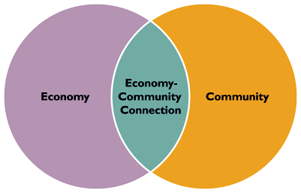
CONNECTING OUR ECONOMY AND COMMUNITY
Solano County’s economy and community continue to transform while showing some signs of resiliency. Clearly, the economy has experienced stress as a result of the recession. However, while jobs have been lost in some industries, other industries are growing and new industries are emerging as per capita income remains higher than California and the nation. Underlying business dynamics have been strong while the number of workers employed in the county and their educational levels have increased. After a spike in foreclosures, home affordability is now improving as foreclosures decline and sales increase. The resiliency of Solano County’s response to external economic forces will determine the long term health of its economy and community.
The past year has been very challenging as Solano County felt the force of a national recession caused by a global financial meltdown. Families have suffered as unemployment spiked to over 10 percent and businesses have had to deal with declines in sales and profits.
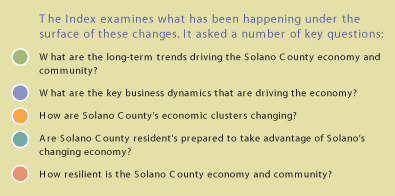
With job losses in both 2008 and 2009, Solano County employment still fared better than the state between 2000 and 2009. Even after the downturn began in 2007, a net of 1,290 establishments were created in Solano County as a result of a dynamic business climate.
While total employment in cluster industries declined from 2007-2008, led by decreases in construction, there was growth in two clusters: 1) Health & Social Services and 2) Trade & Logistics. New clusters are emerging, including energy.
While the number of workers in the county has risen, so too has the educational level of employed residents in the county. Between 2005 and 2008, the percentage with Bachelor’s Degree or higher increased by 5 percent.
After a sharp increase in home foreclosures in 2008, the number of foreclosures dropped 19 percent in the first half of 2009 compared to the first half of 2008. As home affordability has improved, home sales are increasing.
Thus while Solano County has been hit by turbulent economic forces, it has also shown signs of resiliency as a result of underlying business dynamics, changing economic clusters, talent shifts and a housing correction. The question now is how to help residents and businesses of Solano County take advantage of opportunities as the county emerges from recession.